Beyond Human-in-the-Loop: Gunasai Muppala on Building AI Systems That Can Be Tested, Challenged and Overridden
2026-10-28
Kaito Matsumoto
The AI Architect, New York
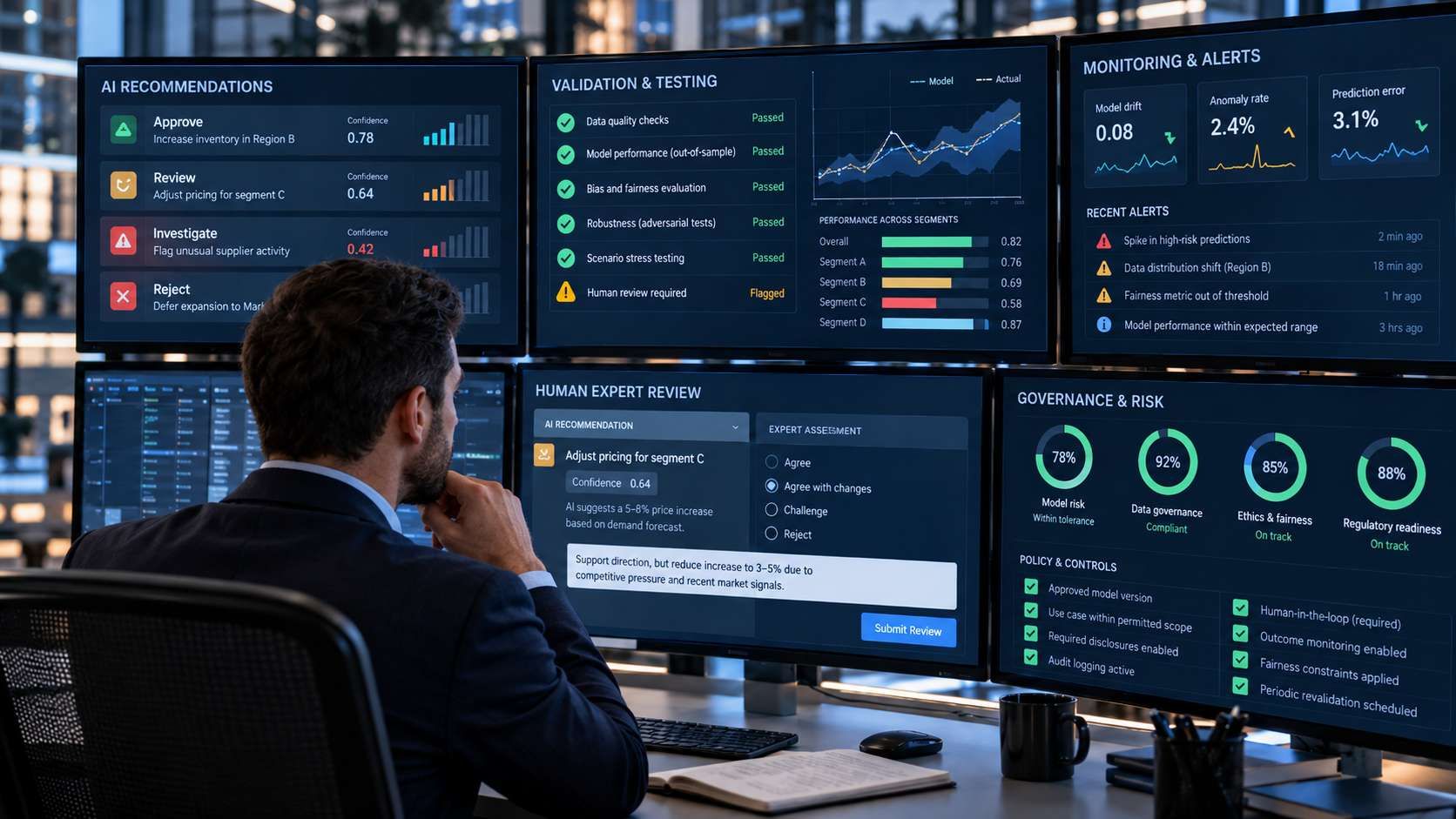
From Analytics to AI Oversight
Gunasai Muppala's work has increasingly focused on the infrastructure surrounding artificial intelligence: how AI-assisted decisions are tested, validated, monitored, secured, and governed after a model begins influencing real-world outcomes.
That distinction matters because increasingly capable models do not automatically produce increasingly reliable systems.
Muppala's technical foundation began with Computer Science studies in India and later expanded through a Master's degree in Business Analytics at Arizona State University. Computer science taught him how systems are built. Business analytics introduced a different question: how can an organization demonstrate that a system or intervention actually improves an outcome?
That question followed him through multiple industries and shaped a practical orientation toward measurable evidence and defensible decisions.
At Better Being Co., formerly Nutraceutical, Muppala worked in business intelligence, analytics, reporting, automation, and operational decision support. Better Being's brands and products are distributed in more than 65 countries. Working within an organization with that kind of operating footprint reinforced an early lesson: information becomes useful only when organizations define appropriate metrics, interpret outputs correctly, and translate them into decisions people can defend.
At Meta, his work in analytics and product operations associated with commerce experiences exposed him to experimentation at very large scale. Meta's family of apps now reaches roughly 3.6 billion daily active people. At that scale, product changes require more than predictive accuracy. Teams need hypotheses, success criteria, experiments, guardrails, and mechanisms for detecting unintended outcomes.
Financial-services work involving Discover and Capital One brought these concepts into environments affecting consumers. Capital One now serves more than 100 million customers. Muppala's work involving remediation, acquisition, fraud, risk, and experimentation reinforced the importance of identifying analytical errors and understanding how those errors can propagate through a decision process.
Today, as an Engineering Analyst working in Account Security and Trust & Safety at Google, Muppala operates in an environment where analytical scale and human judgment must coexist. Google says it has 13 products with more than one billion users each, including five with more than three billion.
Security systems in environments of that scale have to process rapidly changing patterns, while adversarial settings make blind reliance on automation particularly risky because malicious actors intentionally adapt to detection mechanisms.
These figures describe the scale of the organizations and platforms where Muppala has worked; they are not claims that his individual projects personally affected every user or customer. Their relevance is that experience across different high-impact environments repeatedly exposed the same structural problem: a model can generate a recommendation, but an organization still needs a mechanism for determining whether that recommendation should be trusted.
A Four-Layer Framework for Testing and Governing AI-Assisted Decisions
Muppala translated those questions into independent research. In Integrating Human Oversight with AI-Based Planning Systems: A Framework for Ethical Business Intelligence and Adaptive Experimentation in Nationally Critical Sectors, he proposed four interconnected layers around AI-assisted decision-making: AI planning, experimentation and validation, business-intelligence and monitoring interfaces, and human-in-the-loop governance.
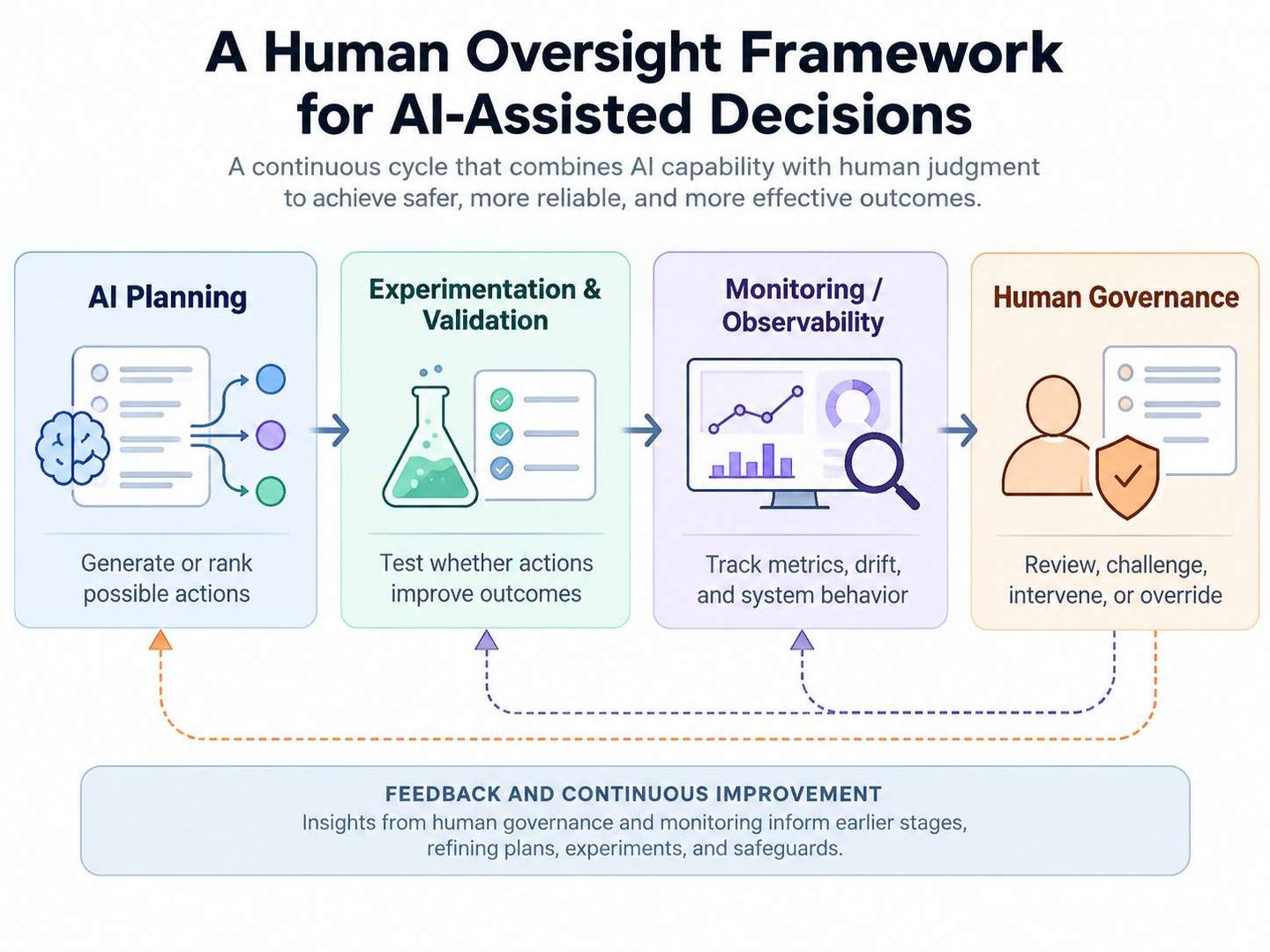
The framework is intended as a general architecture that can be adapted to different sectors rather than as a proprietary product tied to any one employer.
AI Planning
The first layer focuses on AI planning models that process information and generate or rank possible strategies.
Muppala's research discusses approaches including probabilistic reasoning and reinforcement learning as examples of methods that can support planning under uncertainty and adapt decisions based on feedback.
The central question at this stage is straightforward but fundamental: what objective is the system attempting to advance, and what possible actions is it recommending? Without clarity about the objective and proposed actions, later validation and governance become difficult.
Experimentation and Validation
The second layer focuses on determining whether proposed strategies actually improve desired outcomes.
Muppala's research discusses conventional experimentation as well as adaptive approaches such as multi-armed bandits and Bayesian optimization. These methods allow organizations to compare alternatives, incorporate feedback, and refine decisions as evidence accumulates.
The practical objective is not simply to produce another prediction. It is to generate evidence about whether an intervention works as intended and to recognize when it does not. That distinction is particularly important for AI-assisted systems because a recommendation that appears statistically promising is not necessarily the same as an intervention that produces a beneficial real-world outcome.
Monitoring and Observability
The third layer focuses on making AI-assisted behavior visible to the humans responsible for the system.
Muppala's framework uses business-intelligence dashboards as control interfaces that translate AI outputs into understandable charts, metrics, alerts, and performance indicators.
The goal is to allow decision-makers to monitor outcomes, identify unexpected behavior, recognize potential problems such as bias or performance degradation, and understand whether the system remains aligned with its intended objectives. Observability therefore serves as a bridge between technical model behavior and operational decision-making.
Meaningful Human Governance
The fourth layer is human governance.
In Muppala's framework, experts review AI outputs, validate important decisions, interpret contextual factors, and intervene when necessary.
Meaningful oversight requires both information and authority. People must be able to examine an AI-assisted recommendation, question it, understand its limitations, and pause or override an automated process when the evidence or context requires it.
For Muppala, that is an important distinction. "Human in the loop" should not mean simply placing a person at the end of an automated workflow to rubber-stamp whatever the system recommends. It should mean designing systems so that humans have meaningful visibility, clear escalation mechanisms, defined responsibility, and actual authority to intervene.
Why This Matters Now: AI Evaluation as a Lifecycle Problem
These questions increasingly overlap with current U.S. work on AI trustworthiness and evaluation.
NIST's Artificial Intelligence Risk Management Framework treats AI risk as a lifecycle concern. It identifies characteristics of trustworthy AI that include validity and reliability, security and resilience, accountability and transparency, and explainability and interpretability.
The framework is useful to Muppala's thinking because it treats AI risk as an ongoing operational problem rather than a one-time model-development exercise.
In August 2026, NIST released the initial public draft of its TEVV-Athlon Framework for Evaluating AI Systems. TEVV stands for Test, Evaluation, Verification and Validation. NIST describes the framework as a structured, adaptable approach for assessing the real-world performance, impact, and outcomes of AI systems across different technologies and applications.
The White House's 2026 National Security Science and Technology Strategy provides another example. Its updated critical and emerging technology areas include artificial intelligence and autonomy, with planning, reasoning and decision-making, interpretability and control, and adversarial robustness and AI security among the identified subareas. It also identifies information management and cybersecurity, including AI-enabled cyber capabilities and digital identity technologies.
These federal priorities do not mean that every private-sector AI project has national significance, nor do they imply that Muppala's work is government-sponsored. What they demonstrate is that validation, control, security, trustworthy decision-making, and digital identity are broader technical concerns for the United States.
Muppala's own future work is intended to operate within that practical gap.
Portability Across High-Impact Environments
A central element of Muppala's future direction is portability.
His goal is not to create a validation or governance framework useful only inside one company.
One organization may use an AI-assisted system to identify suspicious account behavior. Another may use analytics to detect fraud or prioritize consumer risk. Another may use models to personalize digital experiences, support operational planning, or prioritize interventions.
The applications differ, but many underlying questions remain remarkably similar:
What is the system optimizing? How was the proposed intervention validated? Which types of errors matter most? How can systemic failure be detected? How do decision-makers know when system performance has changed? What evidence should trigger human review? How quickly can qualified people intervene? Who ultimately owns the decision?
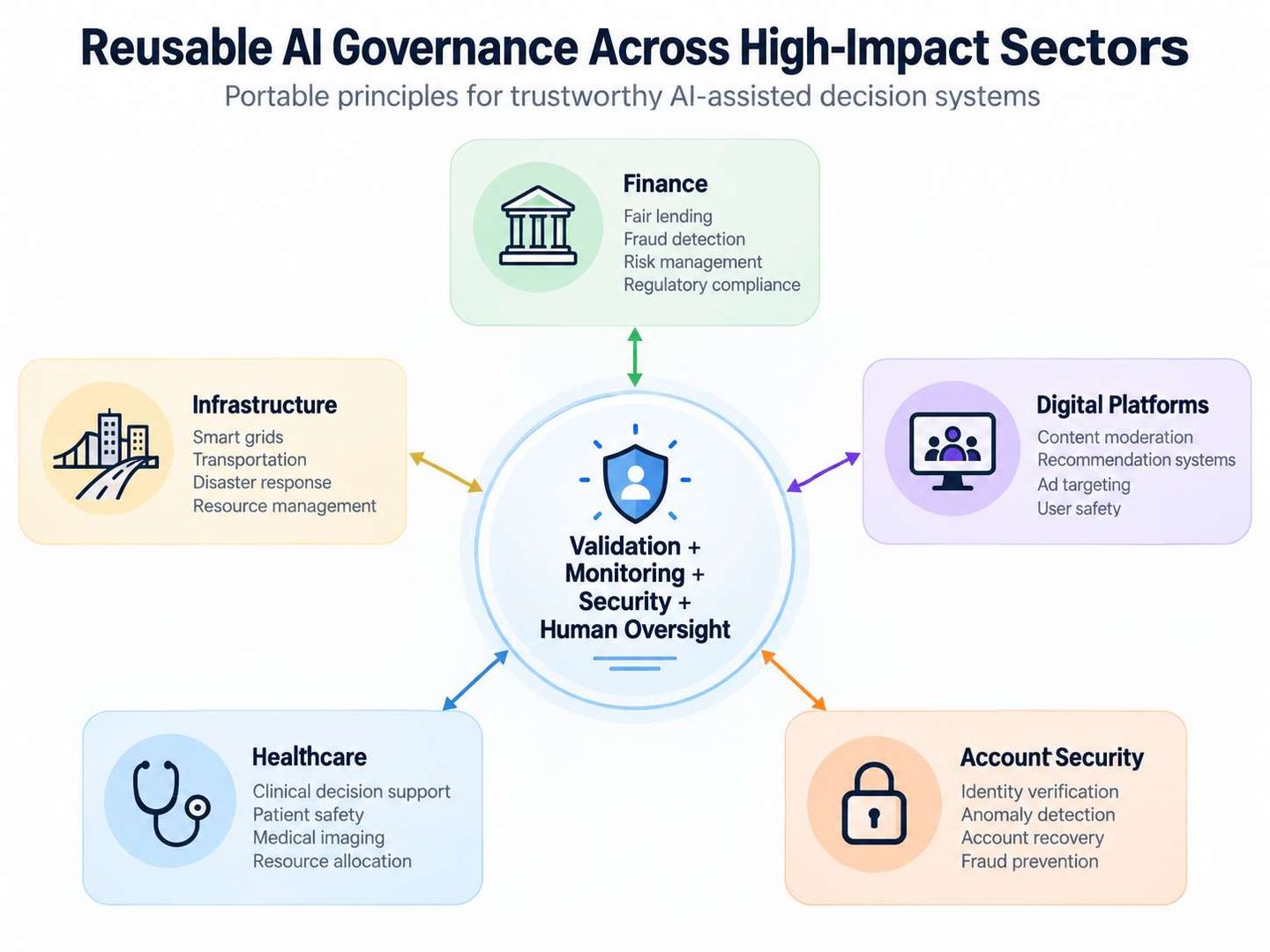
A reusable validation and governance approach can allow lessons from one high-impact environment to inform another without requiring organizations to share proprietary datasets, internal systems, or confidential decision logic. That cross-industry portability is central to Muppala's long-term professional direction.
Over the next several years, he plans to continue developing and applying analytical validation, experimentation, monitoring, security, and governance approaches for AI-assisted and analytics-driven decision systems in the United States. His aim is to combine practical industry experience with methods that can be documented, evaluated, challenged, and adapted by others.
Research, Review, and the Changing Human Role
Muppala's broader publication record reflects an evolution toward this focus.
In Data Science, Analytics, and the AI Revolution: Creating More Jobs and Empowering Careers, he explored AI as an augmentation technology rather than simply a substitute for analytical professionals.
In Why AI Cannot Replace Business Intelligence, A/B Testing, and Human-Driven Insights Across Industries, he examined the continuing role of experimentation, contextual interpretation, traceability, and human judgment alongside increasingly capable AI systems.
Those ideas later developed into his human-oversight framework.
Muppala has also served as a judge and reviewer for professional and research work. He sees that experience as closely related to AI evaluation: reviewing another person's work requires questioning methodology, assumptions, evidence, limitations, and whether conclusions are actually supported by the underlying analysis. Those same habits become increasingly important when organizations evaluate automated recommendations.
His more recent empirical research examines another dimension of human-AI collaboration. In From Job Displacement to Task Reallocation: Evidence from Temporal Analysis of Data Science Job Postings, Muppala compared a historical baseline with 58,830 U.S.-based Data Scientist job postings from 2023. The study was descriptive rather than causal. Its findings were more consistent with task reallocation than with a simple narrative of occupational disappearance, documenting changes in the relative emphasis of analytical skills and responsibilities.
Building the System Around the Model
Much of the current AI conversation focuses on model capability: how accurate, fast, or sophisticated a model can become.
Muppala's long-term interest is increasingly focused on what surrounds the model.
How is a recommendation tested? How are real-world outcomes measured? How are unexpected failures surfaced? How is the system protected when adversaries adapt? How do people understand what is happening? And who has the authority to intervene when the system should not act?
For the United States to capture the benefits of increasingly capable AI systems, organizations will need both innovation and confidence that consequential automated decisions remain measurable, secure, and controllable. Muppala's long-term professional focus is on helping build that bridge through industry practice, independent research, publication, evaluation, and shared methodological rigor.